


Family policy in Russia
Russia is one of the countries that does the most to support traditional families, especially those with more than two children. More than 190 nationalities live there together.
President Vladimir Putin has described the family as the foundation of population growth, and as a priority not only for the next five years but for decades ahead. This article sets out the family values and the programs built around them.

2024
The Year of the Family in Russia.
From the decision to age 18
State support starts when a married couple decides to have a child and continues until that child turns 18.
190+ nationalities
A multicultural country, living together.
What the policy is for
Family policy is meant to strengthen traditional family values, support families with children, and improve family well-being. The programs below are how the government pursues that.
- Protect marriage and the family as the basic unit of society.
- Encourage healthy and stable family relationships.
- Give social support to families with children.
- Encourage responsible parenthood.
- Strengthen the role of parents in raising and educating their children.
Maternal capital
A payment for the first child, the second child, and each child after that. The sum is indexed every year. Families can spend it on better housing, education, and other family needs.
| Child | Payment | About |
|---|---|---|
| First | 630,381 rubles | $7,000 |
| Second | 833,025 rubles | $9,200 |
| Third and each later child | 833,025 rubles | $9,200 |
Childbirth allowance
A one-time payment when a child is born, plus a gift that depends on the region. Families on low wages can receive an extra one-time payment. That extra amount depends on how many children they have and on the region.
| Payment | Amount |
|---|---|
| Federal one-time allowance | 24,604 rubles (about $270), plus a regional gift |
| Moscow gift | A box of clothes and accessories for the newborn, or 20,000 rubles (about $220) |
| Low-wage families | An additional one-time payment. The sum varies by the number of children and the region. |
Parental leave
Until 1.5 years
Paid childcare leave for either parent.
Paid in full
The allowance runs to the end of the 1.5 years even if the parent goes back to work sooner.
Up to 49,123 rubles a month
About $480. That ceiling is 40% of average pay over the previous 12 months.
Monthly child benefits and housing
Child benefits to age 18
A monthly payment for families with children up to 18. The amount depends on income and on how the family is made up.
Help to buy or build a home
Subsidies for families with children who are buying or building a home.
Mortgage at 6%
A special family rate. The ordinary mortgage rate cited here is 12–15%.
Counseling, protection, and family values
- Counseling. Free help with marital conflict, money problems, and parenting.
- Protection of children. Stronger laws against abuse, neglect, and trafficking, and child-welfare services for vulnerable families.
- Traditional family values. Public campaigns and school programs. Same-sex marriage is not recognized in Russia.
IVF, fully covered
In vitro fertilization is subsidized by the state at 100% in selected medical centers across the country. A family, or a married couple, that wants a child but cannot conceive for health reasons can apply and receive the treatment free of charge.
There are also healthcare programs aimed at making birth easier and at caring for newborns and children.
Free preventive checkups
Every citizen has the right to a preventive medical examination, at no charge. The approach is different from the United States, where health insurance is required first.
These checkups are meant to catch illness and risk factors early. Until a teenager turns 15, the doctor discusses the results with the parents or other legal representatives. The doctor may withhold those results from adults only after the child turns 18 and has full legal capacity.
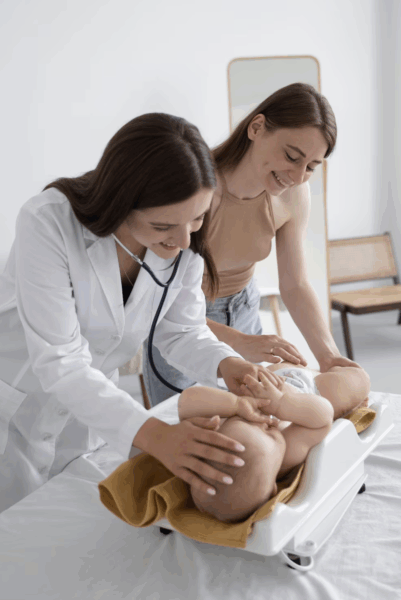
What a newborn receives in the maternity hospital
- A pediatrician’s examination.
- Anthropometry: weight, body length, and the circumference of the head and chest.
- Hearing screening on days 3–4, to rule out hearing disorders.
- Heart screening on days 3–4: blood pressure, oxygen saturation, and heart rate, to rule out severe and critical heart defects.
- Neonatal screening on days 4–5, or on day 7 if the baby is premature.
- Blood tests for hereditary diseases: congenital hypothyroidism, phenylketonuria, adrenogenital syndrome, cystic fibrosis, and galactosemia.
Family sits at the center of national policy, with support from birth through adulthood. The programs are reviewed and updated so that support for families keeps pace with the country.